
[BOYNEXTDOOR] 'Earth, Wind & Fire' MV Explained: A Natural Disaster of First Love
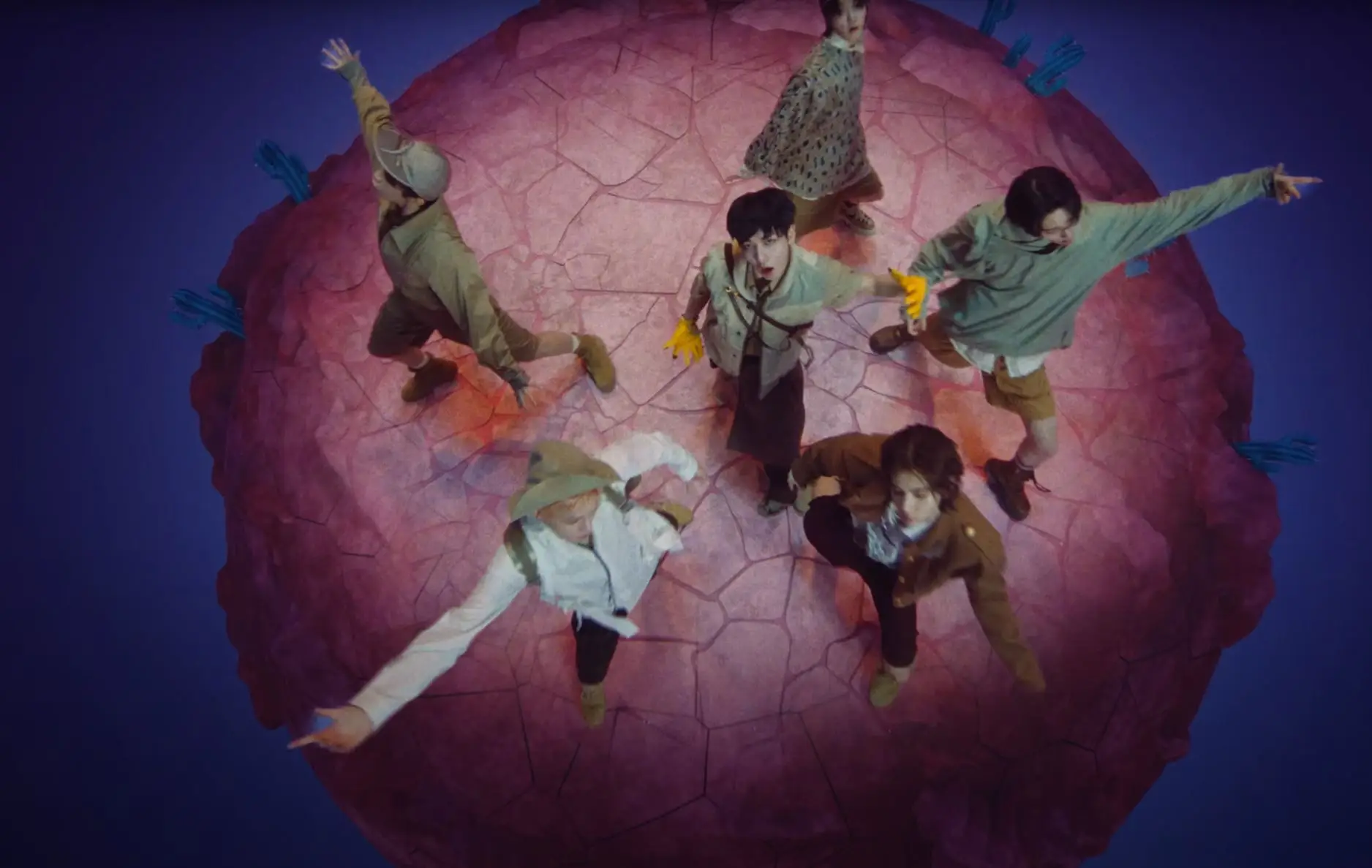
You know that moment when a song just... refuses to leave your brain? A year ago, BOYNEXTDOOR dropped "Earth, Wind & Fire," and I'm still not over it. Not because it's perfect—but because it's perfectly imperfect. There's something about watching six boys dance around a burning car in deliberately fake-looking sets that just works. Let me tell you why this chaotic little masterpiece still hits different.
Source: Official HYBE LABELS YouTube (© KOZ Entertainment)
Table of Contents (Find Your Story)
Quick Summary: The Vibe Check
Here’s the thing about “Earth, Wind & Fire”—it shouldn’t work.
A song that speed-raps through the pre-chorus, uses giant prop pencils, and features a literal car on fire while the members just casually vibe around it? On paper, that sounds like a disaster. But somehow, it became one of 2024’s most addictive comebacks.
Looking back a year later, what strikes me most is how this song captured something the K-pop landscape was missing: genuine playfulness without trying too hard. While other groups were going darker and more intense, BOYNEXTDOOR showed up with toy-box sets and said “what if we just had fun?”
And it worked. The song refuses to leave my rotation. That “ja-ja-gan-da-da-da” part still pops into my head at random moments. The members wrote it themselves, sing it live with handheld mics during intense choreography, and somehow make it look easy.
This is what happens when you give talented kids creative freedom and trust them to know what resonates with their generation.
Credits
The Story You See on Screen
The video opens in a classroom, and immediately something feels off. Not wrong—just delightfully unreal. The papers start flying before any wind machine is even visible. Ties float at impossible angles. It’s like watching a diorama come to life, and that’s exactly the point.
There’s no linear story here, and honestly, there doesn’t need to be. What we’re watching is an emotional progression: the chaos of catching feelings (wind), the intensity of actually feeling them (fire), and finally, the contentment of being in them (earth, represented by that adorable final shot of all six crammed into a tiny convertible under a starry sky).
What got me on repeated viewings is how comfortable they look in this artificial world. They’re dancing around a legitimately burning vintage car, and nobody looks concerned. They’re not trying to “act” cool—they just are. That nonchalance in the face of literal fire is such a perfect metaphor for the song’s message: yeah, love feels like a natural disaster, but we’re vibing with it.
The sets are intentionally cheap-looking. Those oversized pencils? The miniature car at the end? They’re not trying to fool anyone. And that’s the genius—by making the artifice obvious, they create a safe space where these exaggerated emotional metaphors don’t feel melodramatic. Of course you feel like you’re on fire when you’re in love. Of course everything feels like a tornado. The video says: “Yeah, we know it’s dramatic. It’s supposed to be.”
Lyrics & meaning
The Story They’re Telling
Let’s talk about that title for a second. “Earth, Wind & Fire” is technically the name of a legendary funk band from the 70s. Using it as a title is either bold or brilliant—probably both.
But the members (Riwoo, Taesan, and Woonhak wrote on this) aren’t referencing the band. They’re redefining these elements as the fundamental components of a relationship. Wind is the restlessness, the anxiety, the “can’t sit still” energy of a new crush. Fire is the passion, the intensity, the moments that feel too big for your body to contain. Earth is the grounding, the comfort, the “this person feels like home” sensation.
What I love is how the lyrics don’t try to resolve the chaos. The whole song is basically them saying “you’re causing a natural disaster in my life and I’m totally okay with that.” There’s no “calm after the storm” moment—the storm IS the relationship, and they’re choosing to dance in it.
That Speed Rap Section
Can we talk about the 1:09 part? “Baby boo, my sweetie darling, think I love you more”—fans can’t stop replaying this moment.
Taesan reportedly took 27 takes to get it right. TWENTY-SEVEN. And then they perform it live, with choreography, while holding handheld mics. The audacity of writing something that difficult and then refusing to lip-sync it is very on-brand for this group.
That section mimics the physical sensation of your heart racing when you’re around your crush. The words tumble over each other because that’s what thoughts do when you’re overwhelmed. It’s uncomfortable and exhilarating at the same time—which is exactly what falling in love feels like.
The Hook That Won’t Leave
“You’re my Earth, Wind & Fire” is such a simple hook, but it’s been living rent-free in my head for a year.
It works because it takes something cosmic and elemental and makes it personal. You’re not just important—you’re fundamental. You’re not just a person I like—you’re the forces that literally sustain life on this planet.
For a generation that grew up being told to “tone it down” and “be realistic,” there’s something deeply satisfying about a love song that goes this big. No, we’re not being dramatic. Yes, this IS that serious.
Beneath the Surface: A Multi-Layered Analysis
Fan-Favorite Moments That Define The Song
Looking through what fans are actually talking about, certain moments emerge as universally beloved:
0:19 - Taesan’s Opening
Multiple fans timestamped this moment. There’s something about how Taesan delivers “다~ 참아주는데 이번은 못넘어가” (I endure everything, but I can’t let this one go) that hits. His vocal tone here—slightly frustrated, definitely determined—sets the emotional temperature for everything that follows.
0:44 - Riwoo’s Moment
Fans kept coming back to this part. Riwoo’s voice has this unique texture that cuts through the production in a way that feels intimate despite the chaos around it. When he sings “Baby, baby, ready or not,” there’s a vulnerability that balances the song’s overall confidence.
1:23 - Jaehyun’s Rap
This got so many comments. “Jaehyun’s rap »>” became a whole thing. His flow here is effortless—that “Manners maketh man / 몸에 배어 있는 에티켓” delivery shows technical skill while maintaining character. He’s not just rapping; he’s embodying this charming, slightly cocky persona that works perfectly.
1:42 - The Fire Scene
Fans marked this as a favorite repeatedly. The juxtaposition of the members being completely unbothered while literally surrounded by flames is peak BOYNEXTDOOR energy. It’s chaos embraced rather than chaos survived.
1:53-1:54 - The “Lit” Controversy
Multiple fans corrected the official lyrics here: “Baby baby ready or not, baby baby make me feel so lit” (not “good”). This became a community inside joke—fans knowing the lyrics better than the official channel. The word choice matters too: “lit” has that Gen Z energy that “good” just doesn’t capture.
The Styling: Relatable on Purpose
One thing that struck me from day one: these kids are dressed like… kids.
There’s no designer fantasy here. Leehan’s wearing what looks like a Carhartt jacket. Jaehyun’s got what appears to be a Stüssy hoodie at 0:19. These are brands actual teenagers and twenty-somethings wear, not high-fashion labels that cost more than rent.
This was a strategic choice by KOZ Entertainment, and it’s paying off a year later. While other groups are serving untouchable luxury, BOYNEXTDOOR is serving “I might actually know someone who dresses like this.” It makes the entire concept more accessible. The emotional chaos they’re singing about feels more real when they look like they could be your actual neighbor.
Even the colors are muted—lots of blacks, browns, basics. No sparkles, minimal jewelry, sensible sneakers. It’s anti-glamour in the best way, and it lets their personalities and the music do the heavy lifting.
The Sound: ZICO’s Signature Chaos
If you’ve listened to ZICO’s work with Block B, you’ll recognize the DNA here immediately. That high-tension buildup followed by smooth melodic release? That’s his calling card.
The Jersey Club rhythm gives the track this frantic, bouncy energy. Those rapid kicks create urgency, like you’re running toward something (or away from something—emotions are confusing). But then the chorus hits and everything smooths out into this groove that feels like finally catching your breath.
What I appreciate about the production is how much space there is. Modern K-pop can sometimes feel overstuffed with sounds, but “Earth, Wind & Fire” knows when to pull back. The vocal mixing is interesting too—the members’ voices are crisp and forward in the mix. You can hear every word, every breath, every texture in their voices.
And that matters, because when Taesan is speed-rapping at 1:09 or Woonhak is hitting high notes, you need to believe they can actually do this live. The production doesn’t hide behind tricks—it showcases what they can actually do.
The Cinematography: Embracing the Fake
Director Rima Yoon made a choice that could’ve backfired spectacularly: she made everything look intentionally artificial.
That classroom? Those are clearly props. The giant pencils? Obviously fake. The miniature car? Come on. But here’s why it works: by making the artifice obvious, the MV creates its own internal logic. This isn’t trying to be reality—it’s a heightened emotional state visualized.
The scale play is particularly smart. When they’re feeling overwhelmed, they’re dwarfed by giant objects. When they’re in control, they’re commanding the space. It’s visual shorthand for how overwhelming emotions can make you feel small or powerful depending on your relationship to them.
And those colors—cool blues and whites for anxiety (wind), warm oranges and reds for passion (fire), deep blues and greens for comfort (earth). The color grading does so much storytelling work without a single word of dialogue.
The Choreography: Made for Everyone
Here’s what I love about the choreo: I could probably learn it.
Not because it’s simple—it’s not. But because the key moves are intuitive. The wind gesture with those sweeping arms? You don’t need to be a trained dancer to understand what that represents. The fire pops? Clear visual metaphor.
This accessibility was absolutely intentional. A year later, you can still find people doing the “Earth, Wind & Fire” challenge on TikTok because the moves are memorable without being impossible. That’s rare in K-pop, where choreography is often designed to showcase technical skill above all else.
What really stands out is the performance energy. They’re not trying to look cool or detached—they’re engaged, playful, inviting you to join them. The frequent direct camera contact makes you feel included rather than observed. It’s a subtle but crucial difference in performance style.
Fan Takeaways
Looking back at this comeback a year later, what ONEDOORs got from “Earth, Wind & Fire” was something more valuable than chart positions: validation.
This comeback proved that self-producing rookies could compete. That authenticity could win over polish. That fun could coexist with skill. When members write their own lyrics and still deliver them flawlessly live, when they choose handheld mics over lip-syncing, when they trust their audience to appreciate nuance—that builds a different kind of loyalty.
What fans walked away with was pride. Pride in supporting a group that respects its audience enough to show them the real work, the real effort, the real talent. The “27 takes” story about Taesan’s speed rap became a point of connection, not criticism—look how hard he worked to give us this.
The other beautiful thing this era gave fans was community. The comment sections were full of MOAs, LUNEs, ENGENEs, ARMYs—the entire HYBE family showed up. That cross-fandom support wasn’t obligatory; it was genuine appreciation for what BOYNEXTDOOR was bringing to the table. Fans of other groups saw themselves in these boys and wanted to support that energy.
For newer ONEDOORs who joined during this era, they got something special: the feeling of discovering something before it becomes huge. There’s this sense of “I was there when” that makes you feel like part of the story, not just an observer of it.
And practically speaking, fans got a song that holds up. A year later, it’s still in rotation, still making people smile, still prompting new fans to ask “wait, they wrote this themselves?” That longevity is what separates a good comeback from a great one.
Frequently Asked Questions (Q&A)
What does the 'fake-looking' aesthetic in the MV mean?
The deliberately artificial "toy-box" aesthetic creates a surreal playground where exaggerated emotions feel natural. When you're falling in love, everything DOES feel heightened and slightly unreal—so why not make that literal? By embracing the artifice rather than hiding it, the MV gives itself permission to be as dramatic as the emotions it's representing without tipping into melodrama.
Who is the director of the 'Earth, Wind & Fire' music video?
Rima Yoon of Rigend Film directed the MV. She's known for her vibrant, conceptual work in the Korean hip-hop and R&B scene, and she brought that same boldness to BOYNEXTDOOR's vision. Her willingness to lean into the artificial aesthetic rather than fight it made this video memorable.
How is ZICO's influence seen in the song and MV?
ZICO's production signature is all over this track—that high-tension buildup followed by smooth melodic release is straight from his Block B playbook. But more importantly, his philosophy of encouraging member participation in songwriting shaped the entire project. He created an environment where Riwoo, Taesan, and Woonhak felt empowered to write lyrics that actually sound like how they speak, which gives the track its authentic voice.
Why do fans keep correcting the lyrics at 1:53?
Multiple fans pointed out that the line is "baby baby make me feel so **lit**" not "good" as shown in the original video captions. This became a community moment—fans knowing the actual lyrics better than the official source. The word choice matters because "lit" captures that Gen Z energy and excitement in a way "good" simply doesn't.
What's special about the 1:09 part that fans keep mentioning?
The "Baby boo, my sweetie darling, think I love you more" rapid-fire section became legendary among fans. Taesan reportedly took 27 takes to nail it, and they perform it live with full choreography. It's become a defining moment of the song—technically challenging, incredibly catchy, and proof of their commitment to live vocals over easy solutions.
Sources & Technical Data
Credible Sources
You Might Also Like

SEVENTEEN's 'THUNDER': When 10 Years of Brotherhood Becomes One Electric Moment
ENHYPEN's 'Outside' MV: When NI-KI's Voice Became the Weapon Nobody Expected
Comments